Convert TIFF to HEIC on Mac
Select the TIFF files in Finder, press ⌥ F, choose HEIC and press Return. FileFlip saves each HEIC next to its original and works without an internet connection.
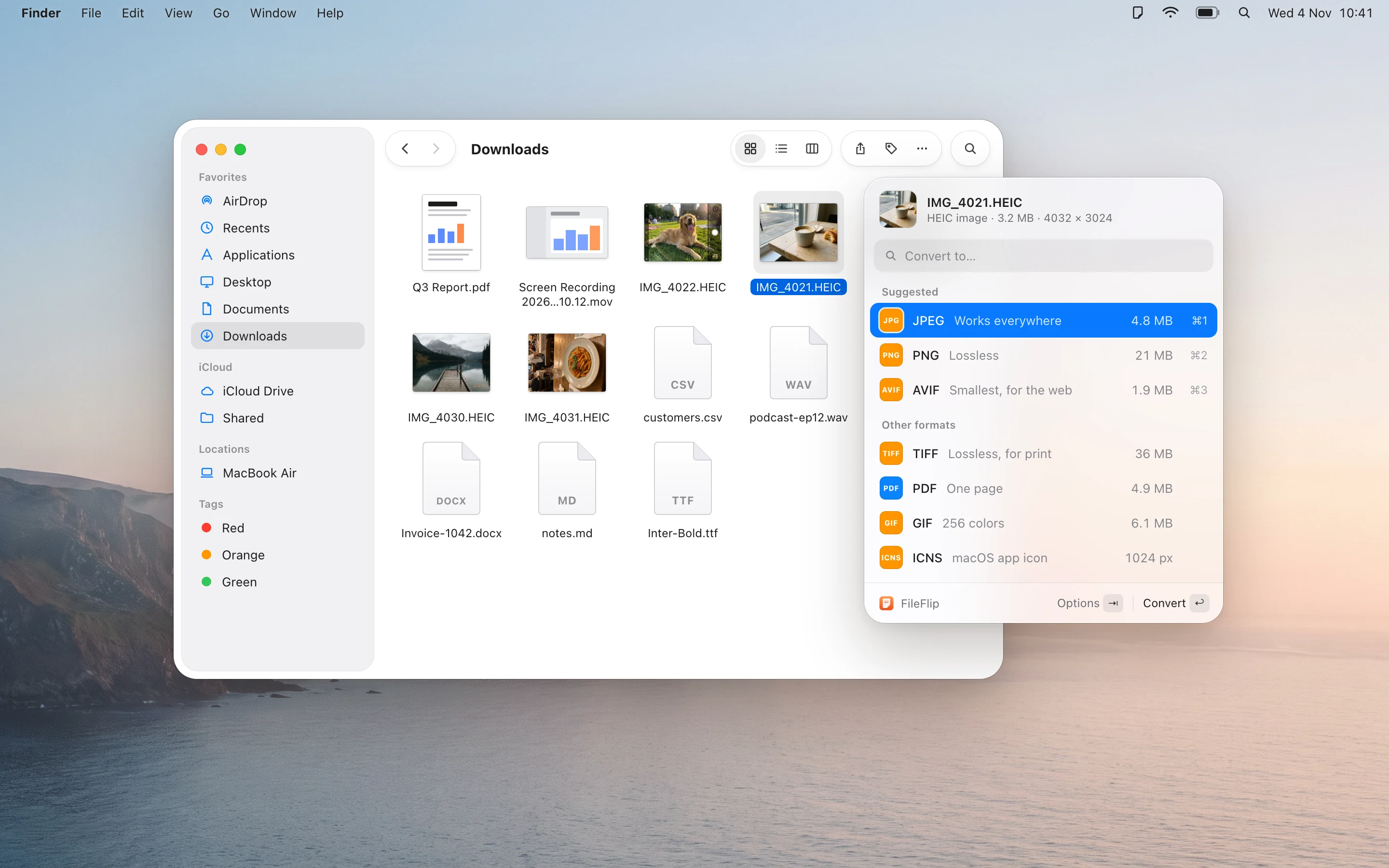
How to convert TIFF to HEIC with FileFlip
Select the TIFF files
In Finder or on the Desktop. One file, or a whole folder with ⌘ A.
Press ⌥ F
FileFlip opens next to the selection and lists the formats it can make from TIFF. Type “HEIC” to jump to it.
Choose HEIC and press Return
The HEIC files appear next to the originals. To make them smaller first, press ⇥ and lower the quality or size.
TIFF and HEIC
TIFF files are very large and web browsers and many apps won’t show them. HEIC keeps photos small on Apple devices, which helps when storage is tight.
What changes when you convert
- HEIC is lossy: the file gets much smaller and some fine detail is discarded. At high quality settings the difference is hard to notice.
- HEIC opens on Apple devices, but not everywhere else. Check before you send it to someone on Windows.
| Property | TIFF | HEIC |
|---|---|---|
| Full name | Tagged Image File Format | High Efficiency Image File Format |
| Made by | Aldus, now Adobe | MPEG (Moving Picture Experts Group) |
| Introduced | 1986 | 2015 |
| Compression | Usually lossless or uncompressed | Lossy (HEVC) |
| Transparency | Yes | Yes |
| Best for | Printing, scanning and archiving | Storing photos on Apple devices |
| Opens in | Preview, Photoshop and most image editors; most web browsers don’t display it | Apple devices; Windows needs the HEIF and HEVC extensions; many websites don’t accept it |
| File extension | .tiff, .tif | .heic, .heif |
| In FileFlip | Opens and saves | Opens and saves |
Other ways on a Mac
For one file now and then you may not need FileFlip. These work with what’s already on your Mac.
Preview
Open the TIFF in Preview, choose File → Export, pick HEIC from the Format menu and click Save. For several files, open them together, select all thumbnails in the sidebar and choose File → Export Selected Images.
Good for a few files now and then.
Terminal
The sips command converts images in place or into a new file.
sips -s format heic scan.tiff \
  --out scan.heic
Built into macOS and good for scripts. Run sips --formats to see what your macOS version can read and write.
Questions about TIFF and HEIC
Does converting TIFF to HEIC lose quality?
HEIC is lossy: the file gets much smaller and some fine detail is discarded. At high quality settings the difference is hard to notice.
Can I convert many TIFF files at once?
Yes. Select them all in Finder, press ⌥ F and choose HEIC. Progress moves to the menu bar, so you can close the panel and keep working.
Will the HEIC keep the date, camera and location?
Yes, metadata is copied by default. Turn on “Remove location” in the options before you share photos publicly.
Where is the HEIC file saved?
Next to the original, with the same name and the .heic extension. The TIFF file isn’t changed. In Settings you can choose a different folder instead.
Can I convert HEIC back to TIFF?
Yes, FileFlip converts HEIC to TIFF as well.
Are my files uploaded anywhere?
No. FileFlip converts files on your Mac and works with the internet turned off.
Convert a whole folder of images at once
FileFlip also handles video, audio, PDFs, documents and data files. Requires macOS 14 Sonoma or later.
Coming soon for Mac